Blog

YOUTH ATHLETE HEALTH:

Pain and Injury in Children and Adolescents

Growing up is a big part of being a young athlete. As children move through different stages of growth and puberty, their bodies can change rapidly, affecting how they move, train and respond to physical activity. These changes can sometimes be accompanied by pain or an increased risk of injury.

Author:

Aaron Hull, Physiotherapist

|

Published Jan 19, 2021

Share this Article:

Children and adolescents are not mini adults. Increased pain, injury and lack of enjoyment are commonly observed as they progress into adulthood. As coaches and parents, it is vital that we understand the processes underlying these changes. There are many evidence based interventions that can be used to guide young people through these periods—to facilitate healthy athletic and personal development into adulthood.

What is growth and maturation?

Maturation of the human body does not proceed in concert with chronological age. Rather, it is generally governed by heredity (i.e., genes), the environment, and a combination of growth- and sex-related hormones. Thus, children of the same sex and age can demonstrate marked variance in maturity, with some individuals mature in advance or delay of others.

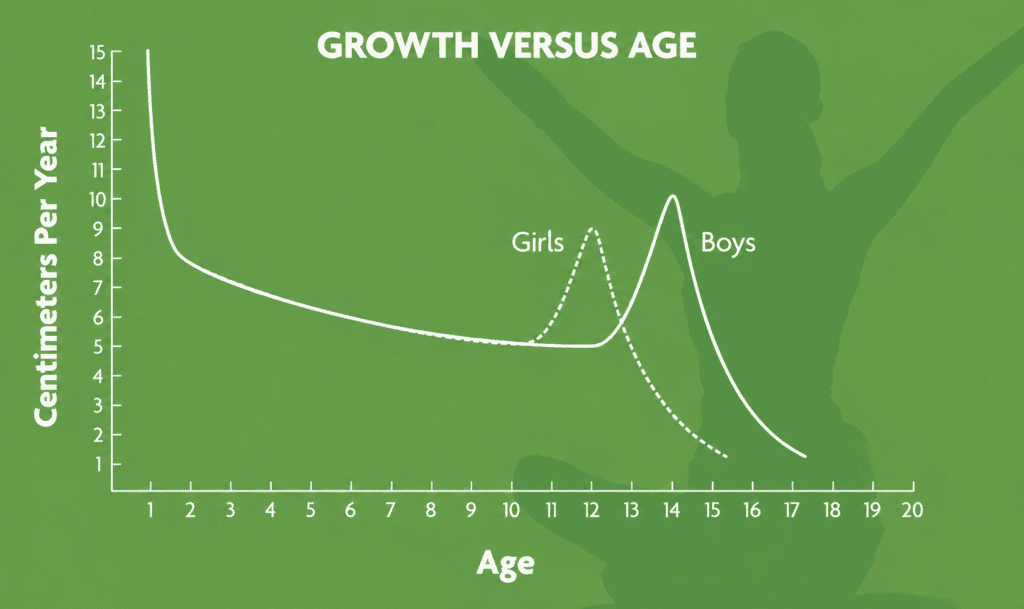
Graph showing growth rate changes with age in girls and boys

Why Pain and Injury Can Increase

  • During growth spurts, the growth plates of these bones are less resistant to tensile, shear and compressive forces compared to adult bones.

  • Just prior to the onset of a growth spurt, there is a decrease in bone mineral density making the bone less resistant to load. 

  • Tendons of muscles insert onto the bones around the growth plates causing irritability.

When is this most likely to happen?

  • Changes in height of greater than 7cm per year.
  • When a young person is between 88-92% of their predicted adult height.
  • 2-3 years earlier in girls.
  • Heel pain around the ages of 7-15 years.
  • Knee pain around the ages of 10-12 (girls) and 13-15 (boys).
  • Change in recent loading. Usually commencing a new sport or returning after the off-season.

Can this be assessed?

Yes. Predictive equations and a detailed physical examination are performed to determine whether a young person is pre, during or post growth spurt. Each person can then be managed individually based on where they are at with their growth and maturation.

How are these symptoms managed?

  • Reassurance and education of the athlete and parents. 

  • Development of load management strategies to continue performing physical activity during periods of pain.

  • Corrective and preventative strength and mobility exercises.

  • Regular monitoring of growth and maturation.

Supporting young athletes through growth

The growth spurt is a normal process in which young athletes can be managed through. By identifying a child or adolescents’ stage of growth and maturation, optimal environments can then be established for their development and enjoyment. 

If you have any questions, or would like to book in for an assessment, give our All Stars a call on 3399 3318.

Help Them Keep Moving

Table of Contents