
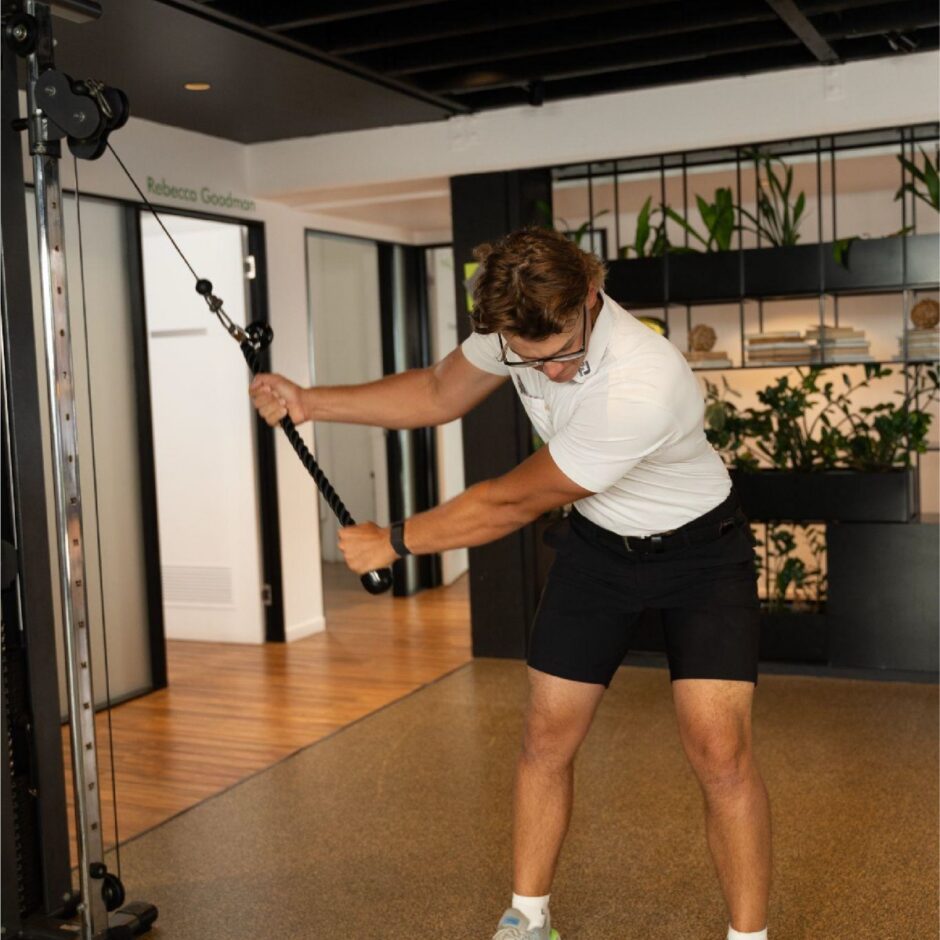
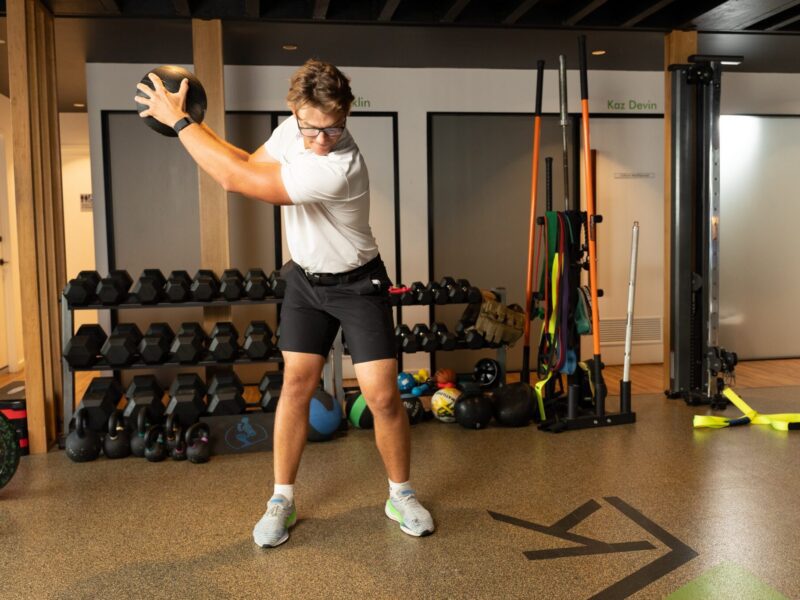
What Real Power Actually Means
According to Titleist Performance Institute (TPI), power isn’t just about how fast you move the club. It’s about how effectively your body:
- Generates force
- Transfers it through the hips and trunk
- Sequence your body components
That’s why two golfers with the same swing speed can hit the ball very different distances… and why one keeps getting sore while the other doesn’t.
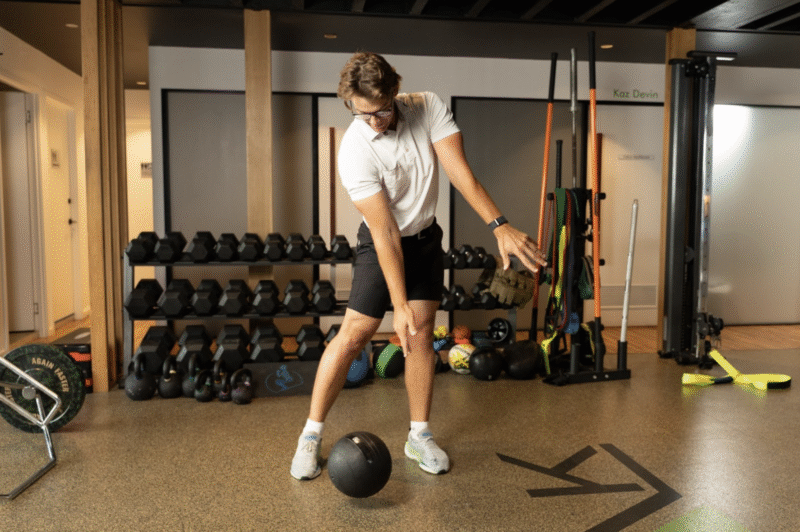
Power Declines With Age: Unless You Train It Properly
TPI research highlights something many golfers quietly notice but rarely understand:
- Loss of distance isn’t inevitable.
- Loss of power is optional.
- Power does naturally decline with age, unless it’s trained intelligently.
- Golfers who maintain distance later in life aren’t swinging harder.
- They’re simply better at producing power relative to their body and age.
The challenge?
Most golfers have no idea where they sit on that spectrum, unless you get measured!
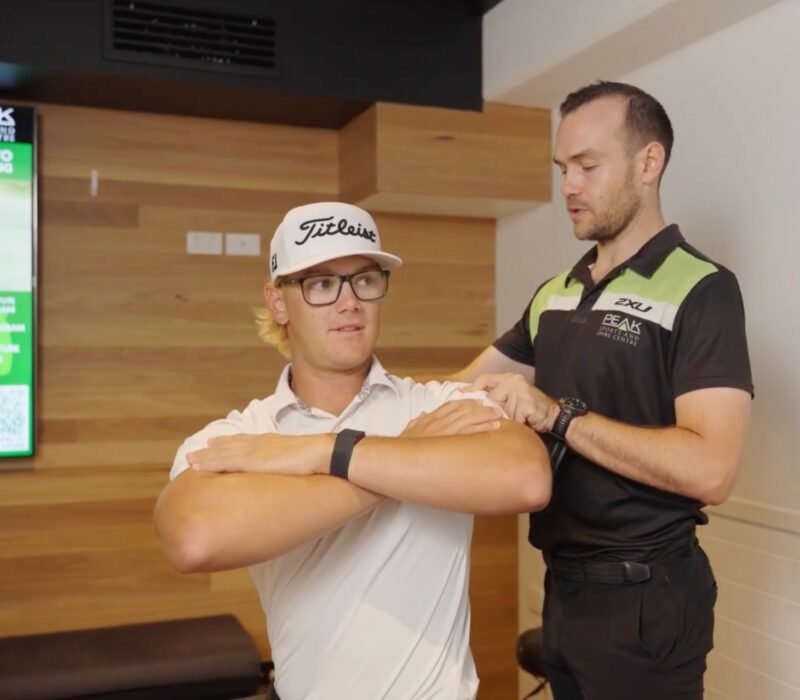
This is Where Power Testing Changes Everything
A TPI Power Assessment doesn’t guess.
It shows us:
- How powerful you are compared to golfers your age
- Whether your lower body is doing its job
- If your upper body is compensating
- Where speed training will help — or hurt
In short, it answers a crucial question:
Is your body ready to produce more speed safely?
BEFORE YOU CHASE SPEED Before You Train Fast, You Need to Be Ready
Without adequate power capacity and control, golfers often experience:
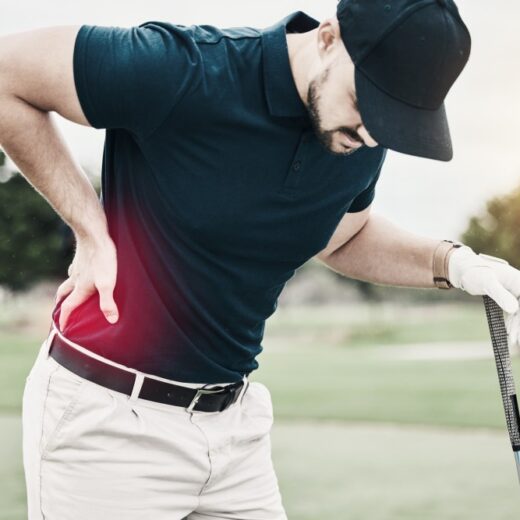
2. Hip or rib pain

3. Elbow and wrist overload

4. Inconsistent contact and timing
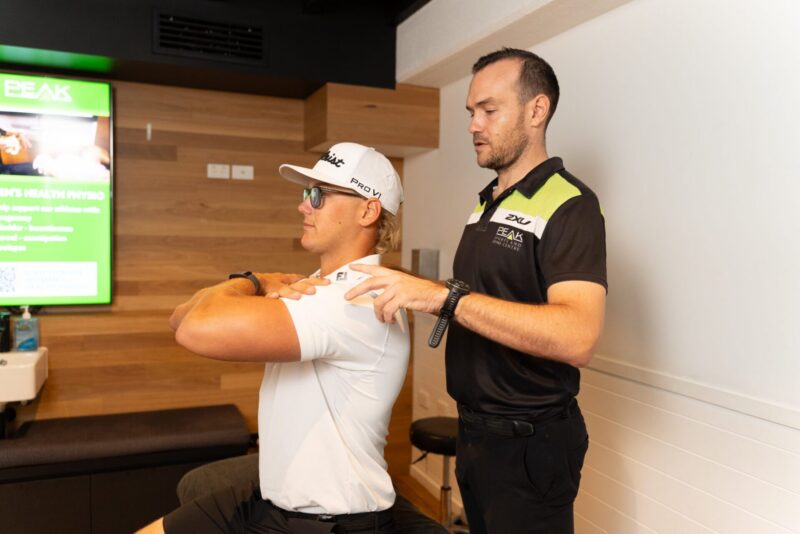
At PEAK Golf Athlete, we don’t chase speed first.
We build the engine before flooring the accelerator.
We want to deem you safe before you begin overspeeding training.
We want to ensure you don’t return to us in PAIN, by trying to chase PERFORMANCE.
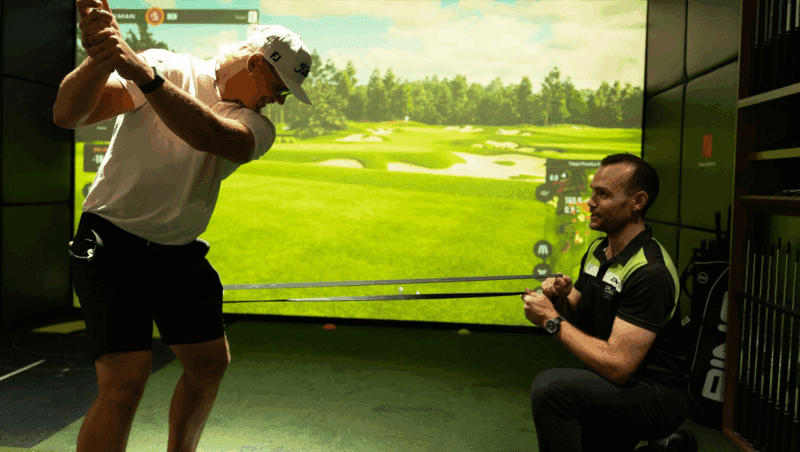
What the TPI Power Assessment Actually Tells You
We assess:
- Lower body power (your main engine)
- Rotational power (how force moves through your trunk)
- Upper body contribution (often overworked when the lower body underperforms)
- Control and repeatability
From this, we answer three key questions:
- Can you create power?
- Can you control power?
- Can you repeat power, round after round?
BEFORE YOU CHASE SPEED Why This Matters for Your Golf
Golfers who understand their power profile:
 Train smarter, not harder

Reduce injury risk
Make better swing changes
When Overspeed Training Is Appropriate
You’re Working Hard. So What’s Missing?
If you’ve ever thought:
“I’m working so hard… why am I not getting longer?”
The answer might not be your swing.
It might be your power profile.
And that’s exactly what the TPI Power Assessment is designed to reveal.
Read the latest articles

Listening to Your Body: David Robertson’s Smart Decision Before Fight Camp
For combat athletes, toughness is often worn like a badge of honour. Showing up to training sore, pushing through fatigue, and grinding through hard...
Read more
Femur Stress Fracture Recovery: Tess’ Ironman Comeback
In October last year, Tess got the news that every endurance athlete dreads to hear: a bone stress injury to her femur. Not a...
Read more
Dream Big: Karen’s Antarctic Kayaking Adventure
At PEAK Sports and Spine Centre, we often encourage our athletes to Dream Big. For some people that means returning to sport after injury....
Read more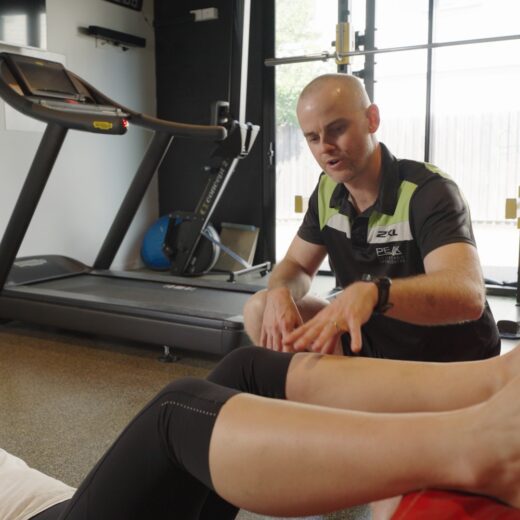
How to Treat Tendon Pain (And Why the Right Loading Matters)
Tendon pain is one of the most misunderstood injuries. It rarely behaves like a typical “strain,” it doesn’t always swell, and complete rest often...
Read more
Understanding Rectus Diastasis During Pregnancy
Rectus diastasis can be a common concern for mothers post birth particularly as to whether it will always be present and how it may...
Read more
Believe
The real race begins in your mind. by Nathan Denham, PEAK Coach and Physiotherapist
Read more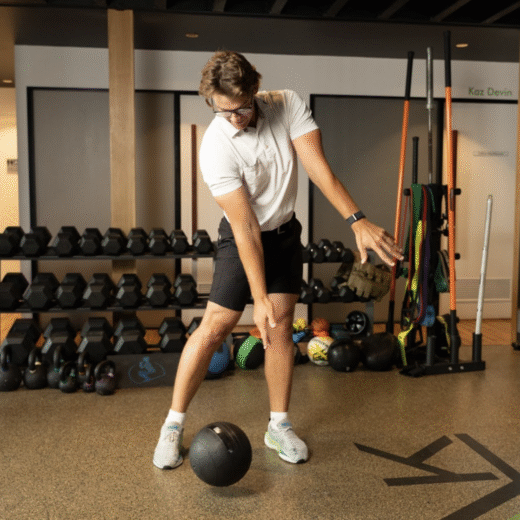
How Powerful Are You For a Golfer Your Age?
Every golfer wants more distance to outdrive their golfing friends! But here’s the question most golfers never stop to ask: Is my body actually capable of...
Read more
Back to Running After the Festive Period: How to Start Strong (and Stay Injury-Free)
The festive season is great for rest, relaxation, and a little indulgence. But once January rolls around, many people lace up their runners again...
Read more
Physiotherapy for MMA Neck Injuries: Why Neck Training Matters More Than You Think
Mixed Martial Arts is one of the most physically demanding sports in the world. Fighters train to strike, grapple, defend, and adapt under intense...
Read more
Recovery Pathway: Life After BPPV
Understanding Residual Dizziness & The Power of Vestibular Rehab
Read moreNot exactly what you're looking for?
View all articlesLet's get started — How can we help?
Physiotherapy

Chiropractic

Podiatry
Massage Therapy

Women's Health Physiotherapy

Running Program Tailored To Your Goals

Joint Mobilisation

Active Release Technique

Exercise Prescription
Real Time Ultrasound Imaging

Spinal Manipulation

Functional Movement Screen
Knee Pain Treatment
Hamstring Strain Treatment
Hip Pain Treatment
Upper, Middle & Lower Back Pain
Neck Pain Treatment

Shoulder Pain & Rotator Cuff Tear
Can't find what you're after?
View all Services
Make an appointment
Or email the PEAK team at info@peakssc.com.au
Hawthorne
- Phone: (07) 3399 3318
- Fax: (07) 3319 6577
Address
5/171 Riding Road,Hawthorne, QLD, 4171 Get Directions
Opening Hours -
6 days per week
- Monday - Friday: 7:00 am - 8:00 pm
- Saturday: 7:00 am - 1:00 pm
To make a booking outside of business hours, please use our form by clicking here.
New Farm
- Phone: (07) 3399 4668
- Fax: (07) 3319 6577
Address
1/15 Lamington Street,New Farm, QLD, 4005 Get Directions
Opening Hours -
6 days per week
- Monday: 7:00 am - 8:00 pm
- Tuesday: 7:00 am - 8:00 pm
- Wednesday: 9:00 am - 8:00 pm
- Thursday: 10:00 am - 8:00 pm
- Friday: 7:00 am - 3:00 pm
- Saturday: 7:00 am - 3:00 pm
To make a booking outside of business hours, please use our form by clicking here.